![SWTB_logo_rgb_color_mode-wPadding-2000x961.png]](https://help.softwaretoolbox.com/hs-fs/hubfs/SWTB_General/Images/Press_Kit/SWTB_logo_rgb_color_mode-wPadding-2000x961.png?height=50&name=SWTB_logo_rgb_color_mode-wPadding-2000x961.png)
In 2005 the Sultanate of Oman issued a Royal Decree to develop the giant Mukhaizna oil field covering a vast expanse of desert in the center and south of the country. A major worldwide producer of oil, natural gas, and chemicals was given responsibility for developing the Mukhaizna field, and from 2005 to 2008 oil recovery rates were increased by more than 600% through the use of a steam-assisted gravity drainage process. As each year goes by, the company makes every effort to continuously upgrade technology and improve productivity of the field.
Eight separate production facilities in the Mukhaizna oil field are using Rockwell PLCs, linked though the TOP Server to Iconics HMI/SCADA systems for data visualization and operator control. Each facility had a specific function which included extracting oil from the ground, separating the oil, and water, gas and steam injection on the final product to test the density. All locations have tanks, pumps, compressors, valves, etc. that monitor and control the temperature, pressure and flow of these different components which are critical to day-to-day operations.
One of the key ways of determining areas for productivity improvement is through the data collection and monitoring systems. Enhancements in data collection and monitoring systems have created improvements in responsiveness as the system changes. The effectiveness of these systems in identifying process changes has helped in the rapid expansion of their use in oil field applications. As with many systems, the expansion created new unique problems. The challenges of keeping track of PLC addresses and the addressing of information in the PLC’s is common to any large project, but they ran into a few they were not expecting, like problems with data collection performance and network reliability over distances. The rest of this article covers how these problems were resolved.
The data collection and distribution systems worked well when first implemented, but as the number of data points increased with expansion it became clear to the project engineers that they needed a way to improve data collection performance. So they began to look for a way to streamline the data flow. The solution they found not only performed well, but it created other, significant opportunities for real-time data integration.
At each of the eight locations, Rockwell PLCs are connected to an Iconics Genesis32 HMI through an OPC server. The TOP Server OPC server from Software Toolbox (Cogent's Sales and Technical Partner) gathers data from as many as 20 PLCs, and feeds that to the HMI. As new equipment was brought online, the number of tags in the system approached 30,000, which is normally not a problem for TOP Server. But something was clearly different with this system and it became apparent that some sort of optimization was necessary.
The problem was that the HMI was making cache reads from the TOP Server. Each additional HMI that went online increased the load on the OPC Server and every time the HMI was opened it forced the OPC Server to make a device read. Although these device reads are necessary to make sure the HMI has the most recent data, they involve quite a bit of overhead. The combined effect was forcing the TOP Server to make more requests for smaller amounts of data, slowing the overall data-gathering process.
“The OPC server seemed to be dying under the load,” said Juan Munoz, Project Manager for the Mukhaizna oil field project. “Even at rates as low as once per second, it was difficult to scan 30,000 tags, and get the critical data changes that we needed.” Based on his experience with the TOP Server in other projects, Munoz knew the server itself was not the issue, so he searched the Software Toolbox website for a solution and found the OPC DataHub.
The OPC DataHub, developed by Cogent Real-Time Systems, is a highly optimized data integration tool. It is a memory resident real-time database that provides quick, reliable and secure access to valuable process data and makes it available to other production and management systems, database archives, and remote clients.
Once he started configuring the OPC DataHub, Munoz soon realized how it could solve his data flow problem. Acting as an OPC client to TOP Server, the OPC DataHub can request data based on tag value changes (referred to as “asynchronous advise”). This means that instead of 30,000 tags per second, TOP Server only sends data for a tag when it changes value. It is free to poll the devices in the most efficient way, always keeping the OPC DataHub up to date with the latest data values. The OPC DataHub keeps all the latest tag values in memory, and can efficiently send them to the HMI on each poll.
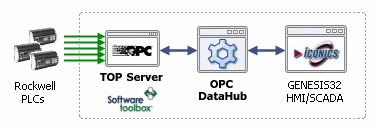
“The OPC DataHub effectively decouples the OPC server from the client,” said Munoz. “All the load is on the DataHub's shoulders now, and the performance is much better.” The TOP Server is now free to optimize the communications to the device while the OPC Data Hub protects it from device reads. This has relieved the company from having to redesign their HMI and PLC configurations from the ground up, saving them tens of thousands of dollars in engineering and development work.
When he was satisfied with the results at the first location, Munoz began installing the OPC DataHub at the seven other facilities. He experienced a similar performance boost, and at the same time created a new data integration opportunity. He now had most of the pieces in place to bring all of the live production data to a central location, using OPC tunnelling.
OPC tunnelling is a reliable and secure way to connect OPC servers and clients over a network. OPC uses DCOM for networking, which is difficult to configure, does not respond well to network breaks, and can pose significant security risks. The OPC DataHub mirrors data from OPC servers and clients over TCP, which is a more robust protocol for networking. Data collection from locations great distances away, which is common in the gas and oil industry, can be a challenge. Tunnelling can greatly simplify the roll-out and stability of these systems. The DataHub reduces the traffic on the network and handles connection losses and reconnections more effectively then standard OPC connections.
To implement OPC tunnelling, Munoz installed another OPC DataHub on a Windows server at the Mukhaizna oil field central office. After configuring tunnelling connections between that DataHub and the remote DataHubs, he was able to access the data from all eight field locations as a single, common data set, without putting any more load on his control system. This data could now be logged and shared at the management level of the company.
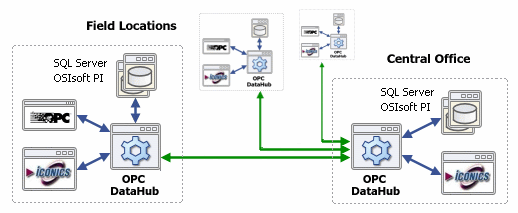
Using the OPC DataHub’s data logging interface, Munoz configured connections to OSIsoft PI and SQL Server databases, to record production data at the remote sites and at the central office. Historical records and reports are now available through standard tools such as SQL and Crystal Reports. Munoz also configured an OPC connection from the central OPC DataHub to an Iconics Web HMI to give managers access to the live data from all of the eight field sites. Operators, on the other hand, continue to control the processes from the HMIs running at the remote locations.
Among the critical information that operators and management need to monitor is the available memory and status of programs running at each field location. The company was able to achieve this by configuring the OPC DataHub's System Monitor feature, which allowed Munoz to add points that monitor the available computer memory and status of the OPC server running at each remote location. This data is accessed locally by operators, and is also tunnelled back to the central OPC DataHub, so it can be viewed by users of the Web HMI on the management network.
“The OPC DataHub is very easy to use,” said Munoz. “In fact, at a recent training session we showed some other people at the company what we are doing, and they are very impressed.”
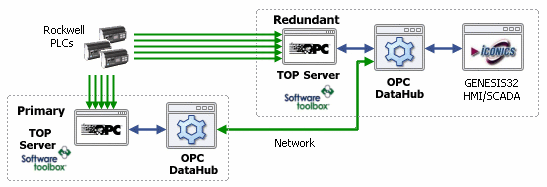
The most recent project that Munoz has decided to tackle with the OPC DataHub is to implement redundancy. To provide increased availability, the company has installed an additional OPC server at some locations. Working with Win Worrall, Product Support Engineer and Developer at Software Toolbox, Munoz has implemented a DataHub script that monitors the quality of the data coming from the local OPC server.
If the quality of an indicator changes to “Bad” or “Not Connected” on the primary OPC server, the OPC DataHub immediately switches to the redundant OPC server and continues collecting data from there. Although this is still undergoing testing before being implemented in the production facility, Munoz reports that there is no data loss during the switchover, and that the performance is very reliable.
Having gained some knowledge of scripting, Munoz has applied it to yet another application for the OPC DataHub. “The scripting language did take a little time to learn, but it is very useful for the types of scripts we need to use. We can develop scripts quickly now, because the language is object oriented.”
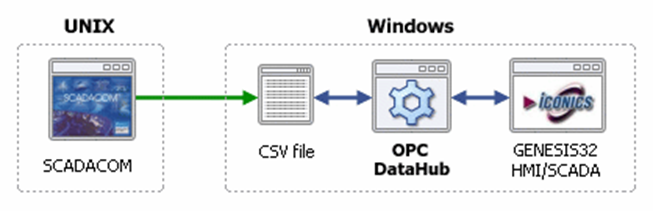
Starting with a demo script from the OPC DataHub archive, Munoz has been able to access data from a legacy UNIX system and make it available through OPC. To access the data, Munoz wrote a DataHub script to read a CSV file every minute and write the values to points in the OPC DataHub. Because the OPC DataHub is also an OPC server, this allows points from the UNIX system to be presented as OPC tags to the HMI system.
“I am impressed with how quickly Juan has picked up the scripting,” said Worrall. “In fact, he's pretty good at getting the most out of the OPC DataHub in just about every way.”
“We are very grateful to Win and the overall support from Software Toolbox on this project,” said Munoz. “We haven’t found many problems. In all aspects, the OPC DataHub is performing very well.”
◊ ◊ ◊
The OPC DataHub, from Cogent Real-Time Systems, is a highly optimized integration tool for real-time data. It provides quick, reliable and secure access to valuable process and production data and makes it available to management systems, database archives, and remote clients. Combining a number of innovative technologies, the OPC DataHub makes it easy for you to access the real-time data you need to make informed and timely decisions that save time, reduce waste, and increase profitability.
Founded in 1995, Cogent Real-Time Systems is the leader in real-time data integration between Windows, Linux and QNX systems. Customers include the Bank of Canada, Cadbury Chocolate and the European Space Agency. Cogent leverages its experience in real-time data communications to provide the next generation of OPC products. For more information, please contact Cogent at info@cogent.ca or visit our web site at www.opcdatahub.com. You can also call us at +1 (905) 702 7851.
DataHub, Cogent, the gear logo and the stylized C logo are trademarks or registered trademarks of Cogent Real-Time Systems Inc.
Since 1996, Software Toolbox has been an industry source for industrial automation software, from project conception to completion. The company has served more than 10,000 clients in 110 countries helping them find, evaluate, purchase and support automation software solutions. These solutions include the OPC DataHub and TOP Server used in this application and OPC servers, clients, and development toolkits, HMI/SCADA add-ins/enhancements, and ActiveX and .NET development tools for Visual Studio C#/VB/C++. Software Toolbox works with its clients in all phases of projects to help them find and determine the right tools to use and to support overall project objectives and maximize their industrial software results. For more information about Software Toolbox visit https://softwaretoolbox.com/.
The Software Toolbox name and logo mark are registered trademarks of Software Toolbox, Inc.
Copyright © 2010 Cogent Real-Time Systems, Inc.