![SWTB_logo_rgb_color_mode-wPadding-2000x961.png]](https://help.softwaretoolbox.com/hs-fs/hubfs/SWTB_General/Images/Press_Kit/SWTB_logo_rgb_color_mode-wPadding-2000x961.png?height=50&name=SWTB_logo_rgb_color_mode-wPadding-2000x961.png)
Introduction
The purpose of this guide is to demonstrate how to make a basic SuiteLink connection to the TOP Server with Wonderware’s System Platform 3 (ArchestrA). We will use System Platform to refer to version 3 and all prior versions (formerly known as IAS/Industrial Application Server). There are a number of different ways System Platform can connect to I/O tags. This basic example uses an Application Integration (AI) Object connecting to a SuiteLink Device Integration (DI) Object which connects to the TOP Server.
The TOP Server in this example will use the Simulator driver and the pre-configured simdemo.opf, both included with TOP Server. The same basic steps can be used to make a SuiteLink connection using any of the 90+ drivers available for the TOP Server. If you do not already have TOP Server installed, the free two-hour demonstration version can be downloaded at https://softwaretoolbox.com/top-server/free-trial. This version functions the same as a fully licensed version within the two-hour demo mode. Stop the TOP Server and restart it for two more hours of runtime.
This guide will also demonstrate how to connect System Platform tags to TOP Server tags and thus to points on your controller. TOP Server does not need to have a tag database for System Platform to communicate with devices using TOP Server. You can directly address the points on the controller to reduce the number of locations that you must create a tag database. However, there are cases where you should create the TOP Server tag database first. This document will also demonstrate the means for System Platform to import the desired tags from a .CSV file exported from the TOP Server tag database. This can be more efficient if there are a large number of tags that need to be created in System Platform.
The information provided here is not a substitute for your System Platform documentation. This procedure is being demonstrated in order to show a complete connection, not to provide comprehensive training on how to build System Platform projects.
Intended Audience
This guide is intended for Wonderware System Platform users who are new to TOP Server. This document makes the assumption that you have some familiarity with System Platform and have configured a TOP Server project (for assistance read TOP Server V6 Getting Started Guide).
Required Software
For FastDDE/SuiteLink Connections, you need:
- Software Toolbox TOP Server version 4.41.159 or higher, and
- Wonderware Industrial Application Server 2/System Platform 3.
See Also: Topic named “FastDDE and SuiteLink Options” in the main TOP Server help file, which is accessible by clicking Help ⇒ Server Help… ⇒ Server Help ⇒ Interfaces and Connectivity from the TOP server application itself.
Basic Connection between System Platform and TOP Server
Installing Wonderware Common Components
In order for the server to allow FastDDE/SuiteLink connections Wonderware components must be installed. If within the TOP Server Project Properties (Right Click the Project folder in the TOP Server tree view) you do NOT see the option tab for FastDDE/SuiteLink, then you will need to install these components. The common components can be installed from the Wonderware Device Integration disk
Run the setup.exe located under \DIFolders\WW\SuiteLink\2.0 SP3\SuiteLink
The TOP Server works with all Common components installs System Platform 2 and 3, but we always suggest using the newest you have available. SuiteLink connections to the server will not function if these components are not installed. The tab, File ⇒ Project Properties ⇒ FastDDE/SuiteLink will be shown or hidden based on proper installation of these Wonderware components.
Enable FastDDE/SuiteLink in TOP Server
When you run the TOP Server you will need to enable FastDDE/SuiteLink Communications by right clicking the Project folder in the TOP Server tree view, navigating to the Tab labeled FastDDE/SuiteLink, and enabling the interface as shown below. If you do not see this tab or it is disabled then you did NOT properly complete the install of the common components, or the Wonderware Suitelink/FastDDE interface was not selected for install during the feature selection process.
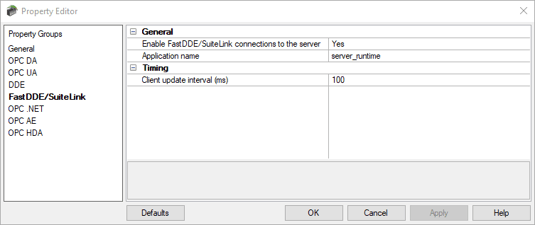
Figure 1: Enable FastDDE/SuiteLink
Configure an Alias in the TOP Server
Each time you add a channel, device, or group TOP Server generates a basic Alias for you. You may also create your own alias mapped to a channel, device or group. Aliases are necessary in the Server since Wonderware does not recognize the ChannelName.DeviceName syntax in the Topic Name because of the dot . characters in the hierarchical structure when you setup the System Platform Access Name. If you are used to setting up Topic Names in other DDE servers, setting up an Alias name in the TOP Server is our equivalent of that step in the setup. To do this in the TOP Server, click on the Aliases option in the TOP Server tree view. The dialog shown below will appear and will already have topics made for you automatically that correspond to your channel names, device names and group names, each separated by underscores. If you don’t have any Aliases make sure you have configured your channel and device first or that the “show aliases” check box is checked.
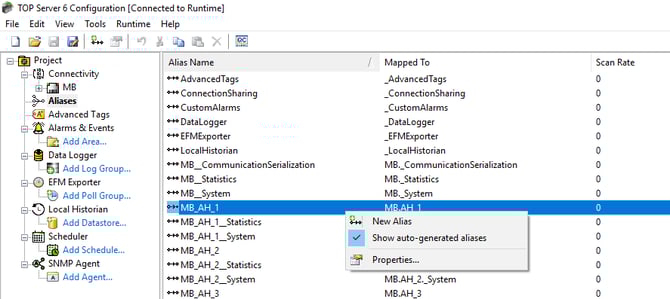
Figure 2: Alias Map
If you have the checkbox “Show auto-generated aliases” unchecked, all you will see are aliases you have entered or will be blank if you have created none.
To create your own alias, right click anywhere in the workspace and add an alias in the dialog shown below that maps your ChannelName.DeviceName to a single word topic name without any spaces or punctuation - this Alias name will be used as the topic name when configuring the System Platform Access Name. In the example below, we created an alias named “Test” that maps to “MB.AH_1” in the TOP Server.
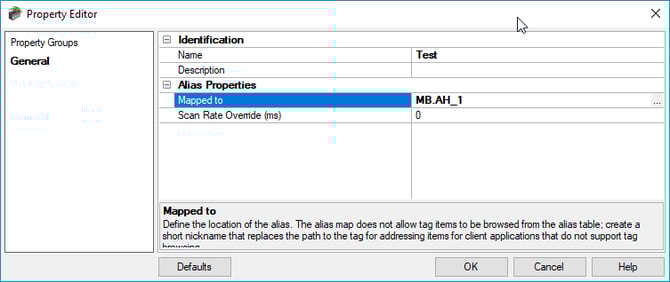
Figure 3: Created Alias
Note that you can create as many aliases (also known as topic names in System Platform), as you like that point to the same or different combinations of a Channel, Device, and Group name.
Configuring System Platform
System Objects Configuration
This example starts with the ArchestrA IDE open using a new Galaxy. Refer to your Wonderware documentation for instruction on how to create a new System Platform Galaxy. For the purposes of this tutorial, we will be using the Deployment View in our sample Galaxy, SWTB1, as seen in Figure 4 below.
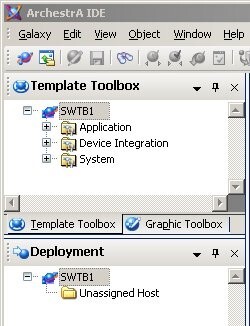
Figure 4: Deployment View
The first step in configuring a new project begins with the System Object in the Template Toolbox. Expand the System Object and highlight the $WinPlatform template object, as shown in Figure 5 below.
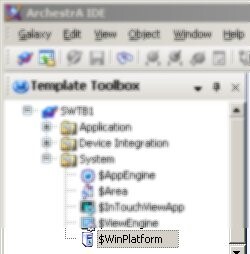
Figure 5: $WinPlatform
Drag and drop the $WinPlatform template object under the Galaxy in the Deployment View as shown in Figure 6 below. This example will use the default names, but you can name these objects as needed for your project.
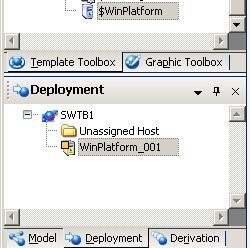
Figure 6: Adding $WinPlatform
The AppEngine is the next System Object we need to create for this project. Drag and drop the $AppEngine template object under the Unassigned Host folder to create your AppEngine_001 object as shown in Figure 7 below.
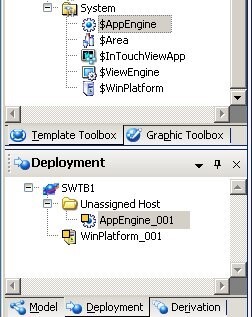
Figure 7: Adding $AppEngine
The final System Object required is the Area Object. Drag and drop the $Area template System Object to the Unassigned Host folder under the Deployment View to create the Area_001 object as shown in Figure 8 below.
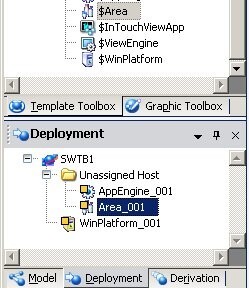
Figure 8: Adding $Area Object
Refer to your Wonderware documentation for a better understanding of how these logical objects work and how to best name them for your system.
The AppEngine_001 object can now be assigned under the WinPlatform_001 object and the Area_001 object can be assigned under the AppEngine_001 object, as shown in Figure 9 below. There is no configuration of these objects required for this example.
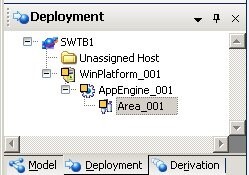
Figure 9: Assigning System Objects
Now that our System Objects are created and in place, we can configure our DI or Device Integration object.
Device Integration Object Configuration
We start by selecting our template object from the Device Integration section of the Template Toolbox as shown in Figure 10 below. The $DDESuiteLinkClient object template is selected because this example demonstrates a SuiteLink to TOP Server connection.
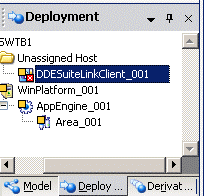
Figure 10: $DDESuiteLinkClient DI Object
Drag and drop the $DDESuiteLinkClient template object to the Unassigned Host folder in the Deployment View as shown in Figure 11 below to create our DDESuiteLinkClient_001 DI Object.
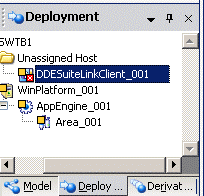
Figure 11: Adding DDESuiteLinkClient DI Object
Double-clicking the DDESuiteLinkClient_001 object under the Unassigned Host will open the object properties to the right of the Template Toolbox as shown in Figure 12 below.
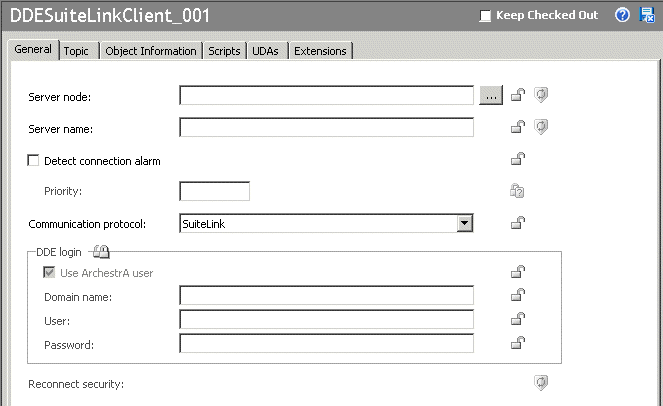
Figure 12: DDESuiteLinkClient Object Properties
Click on the Ellipses Button (…) to the right of the “Server node” text field, as shown in Figure 13 below. If the TOP Server and System Platform are on the same PC, leave the Server Node blank.
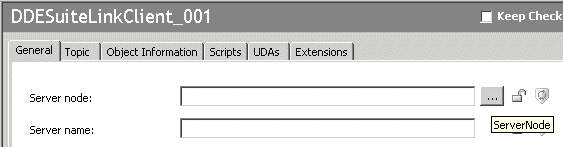
Figure 13: Selecting a Server Node
The Browse Node dialog box will open. You can select the Domain of the computer node where TOP Server is installed. This will then display a list of available computer node names that are available in that domain. For example if the PC is named KMR-IAS-TEST, we will highlight that node name and select OK, as shown in Figure 14 below.
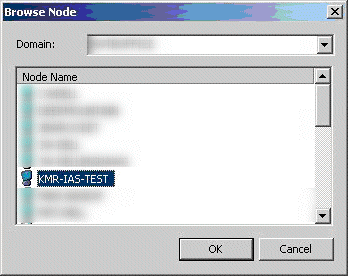
Figure 14: Browsing Nodes
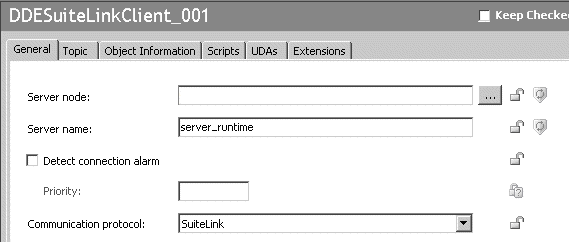
Figure 15: Server Name specification
After the Server node is selected, type server_runtime into the Server name field to tell the DI Object to connect to the TOP Server. Also, select SuiteLink as the Communication protocol.
Next click on the Topic tab as shown below:
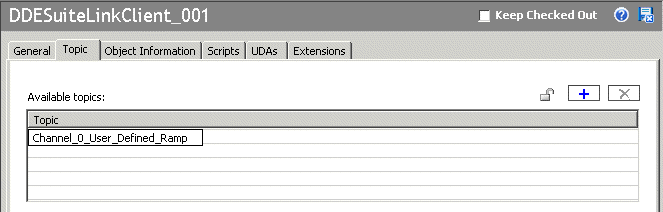
Figure 16: Topic Definition
Click on the blue + icon to the right, as shown above and then enter in the TOP Server Topic name that will be used. Once the topic is entered click on the icon to save and close the DI object.
Assigning the DI Object
Once the DI object is saved you can assign the DI object by moving it under the AppEngine_001 object as shown to the right.
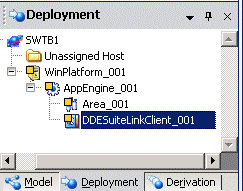
Figure 17: Assign DI Object to the App Engine
Application Object Configuration
The final object needed in order to connect to the TOP Server is the $Integer Application Template, shown in Figure 18 below. We are using this object because the tag in the TOP Server we will be connecting to in this example is an Integer. See your Wonderware documentation for more information on Application Objects.
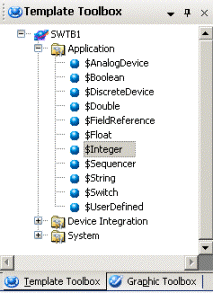
Figure 18: Integer Application Object
Drag and drop the $Integer Application Object under the Unassigned Host folder, as shown in Figure 19 below, to create the Integer_001 Application Object.
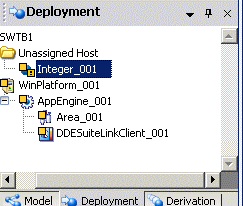
Figure 19: $Integer_001 Object
Open the Integer_001 Application Object properties, as shown in Figure 20 below, by double-clicking the Integer_001 Object.
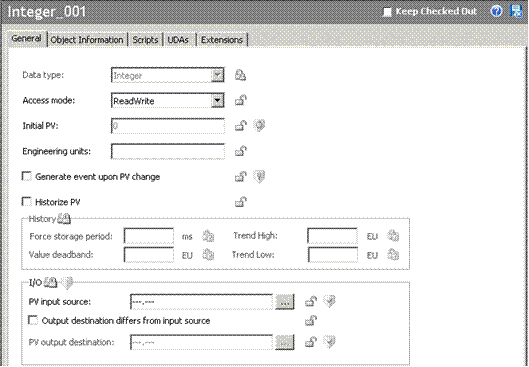
Figure 20: Integer_001 Properties
In the properties of our Integer object, we need to assign an item. This assignment is made in the PV Input Source field, shown in Figure 21 below.
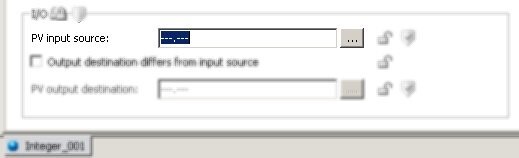
Figure 21: PV Input Source
You can enter the full path and tag name in the PV Input Source. In this case Channel_0_User_Defined_Ramp.ItemCnt or if your not sure what it is you can browse for one of the DI object Attributes and change the last part of the name to the tag name as shown next.

Figure 22: PV Input Source Enter Manually
Alternatively, you can click on the attribute browser button as shown above under the I/O section of the Integer AI Object. The Attribute Browser as shown below will open.
Items added to the Scan Group under the OPCClient Object can be browsed and selected. To browse those items, click the Ellipses (…) Button next to the PV Input Source field. This will open the Galaxy Browser as shown in Figure 25 below.
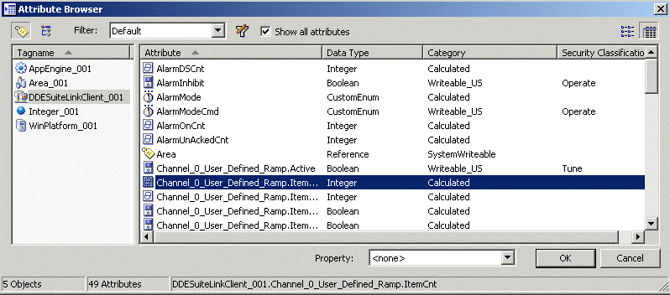
Figure 23: Attribute Browser
Select the DDESuiteLinkClient_001 DI Object we created as shown above. The list of all Attributes for this object will be shown if the “Show all attributes box” is checked as it is above. Highlight one of the Attributes which points to the Topic we created earlier in this document – Channel_0_User_Defined_Ramp. Click OK.
If you had created Attributes in the DI Object that pointed to Tags in the TOP Server or PLC addresses these tags would be in this list and you could select them at this point as an alternative method, but is outside the scope of this document.
Once the Attribute browser is closed highlight the text after the Topic in the PV input source field as shown above in Figure 22. Make sure you don’t include the period or dot as this is needed as a separator.

Figure 24: PV Input, Edit to Reflect Tag Name
Type in the name of the tag, Ramp1, as shown above. The text in the PV input source should now read Channel_0_User_Defined_Ramp.Ramp1 and we are ready to save and close the object. Click on the icon to save the Integer_001 Application Object.
You will be prompted to “Check In” the changes and need to do so by clicking OK. The Integer_001 object now needs to be assigned to the Area_001 System Object in the Deployment View. This is accomplished by dragging and dropping the Integer_001 object from the Unassigned Host folder onto the Area_001 object, as shown in Figure 25 below.
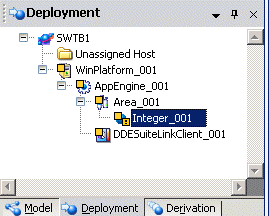
Figure 25: Assigned Integer_001 Object
All objects have now been configured and assigned, so the next step is to deploy the galaxy.
Deploying the Configured Galaxy Objects
To collect live data from TOP Server, the configured objects must now be deployed. To do so, right-click on the WinPlatform_001 object in the Deployment View and select Deploy, as shown in Figure 26 below.
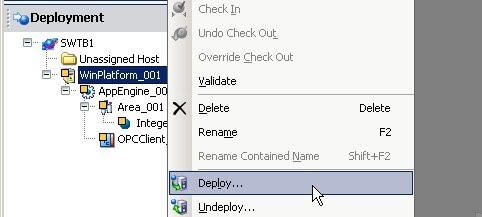
Figure 26: Deploying Objects
This will open the Deploy dialog box, as shown in Figure 27 below.
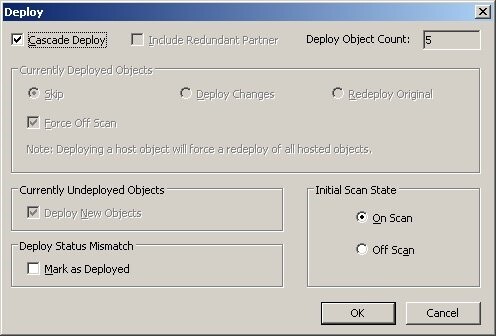
Figure 27: Deploy Window
You will want to use the default settings, which will deploy all of the objects we have configured. To do so, click the OK button at the bottom of the dialog box. The deploy status window will open and you will see the status bar as the various deployment steps are taken.
Once the deployment is completed at 100%, click the Close button, as shown in Figure 28 below.
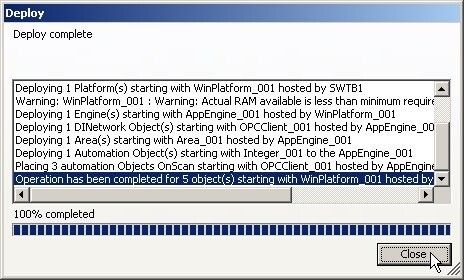
Figure 28: Deployment Complete
Viewing Data
You can now view data updates for the item we have configured by opening the System Platform Object Viewer. Highlight the Integer_001 object in the Deployment View and go to the Object menu of the ArchestrA IDE interface. Select “View in Object Viewer” as shown in Figure 29 below.
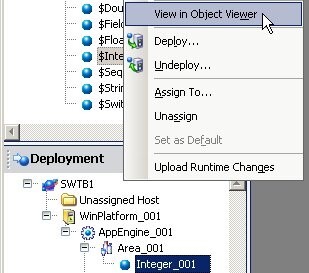
Figure 29: Opening Object Viewer
This opens the Object Viewer where you can view the value and quality of the item we have configured, as shown in Figure 30 below.
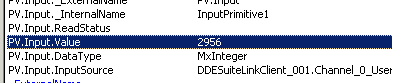
Figure 30: Viewing Data
As you can see, the quality for the item Ramp1 is "Good" and the value is “5760”. This shows the present value. To subscribe to changing values for this item, right-click on the attribute and select “Add to Watch”, as shown in Figure 31 below.
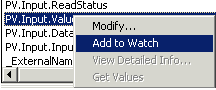
Figure 31: Add Attribute to Watch
This adds the attribute to the watch window at the bottom of the interface where it will receive value updates for the item at the update rate configured for the topic, if the value changes, as shown in Figure 32 below.

Figure 32: Viewing Live Data Values
If the item is not added to the watched list, the item will not receive updates unless the Value field is specifically clicked.
You can also write values to Read/Write eligible items from System Platform. This is accomplished by selecting the “PV” attribute, right-clicking and selecting “Modify.
This opens the “Modify Numeric Value” window, where a value can be entered and written to the item by clicking Apply and then OK, as shown in Figure 33 below.
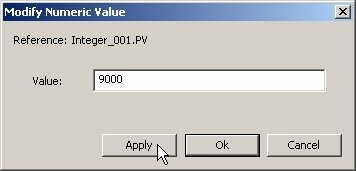
Figure 33: Writing a Value
After the write to the item has succeeded, you will see the value in the Watch List change for the item, as shown in Figure 34 below.
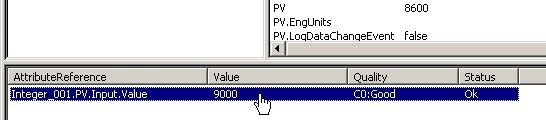
Figure 34: Successful Write
Dynamic Tags
Dynamic tag addresses can be used with the TOP Server instead of adding tag in the TOP Server. In the example here we added the tag name from the TOP Server to the Topic name as created in the DI Object as shown below Figure 35.

Figure 35: PV Input – Dynamic
To make this a dynamic tag we would put in a valid device address for the driver we are using. With the Simulator driver, used in the example, we would use K0001. The text in the PV input source would then read Channel_0_User_Defined_Ramp.K0001 instead of the Ramp1 tag used in the example. In cases when the data type you want to read from a PLC memory address is not the default memory type shown under the Addressing section of the specific TOP Server driver help file you are using, you will need to add the data type information to the end of the text. For example if you wanted to read the K0001 tag as a Float or Real instead of the default Word data type you would use the following test in the PV input source field:
Channel_0_User_Defined_Ramp.K0001@float
The “@float” tells the server that the address K0001 should be read as a float.
The information below will show you a few specific examples of dynamic tags. Remember to check the “Addressing” section of the TOP Server driver help file of the specific driver you are using as you may not need to add this additional information.
Examples:
| Address | Description |
Channel1_Device1.40001@float |
Modbus address 40001 read as a float from Device1 under Channel1 in the TOP Server |
ENet_PLC5.N7:0@short |
AB PLC5 address N7:0 read as a short (signed 16-bit value) from a device called PLC5 under a channel called ENet in the TOP Server |
Summary
This guide has demonstrated the basic steps for configuring a SuiteLink connection from System Platform to the TOP Server using the Simulator driver. This guide is also applicable in configuring SuiteLink connections from System Platform to all of TOP Server’s other 90+ available device drivers.
If you do not have TOP Server but would like to evaluate what TOP Server can offer in terms of robust, reliable device data acquisition, you can download a free two hour demonstration of TOP Server at https://softwaretoolbox.com/top-server/free-trial. This demonstration version is fully functional, only requiring that you restart it at the end of the two-hour demonstration period.
TOP Server also fully supports OPC and DDE client connections in addition to SuiteLink. For tutorials demonstrating connecting InTouch or InSQL to TOP Server please refer to our Wonderware Users Resource website by clicking or copying the following URL into your Internet browser: https://softwaretoolbox.com/top-server/opc-da-ua-suitelink-drivers#client-specific-resources
If you have further questions or need assistance, our experienced staff is here to assist you. We can be contacted in the methods outlined below.
Contact Us
If you have any questions or are seeking further information and help: